
Shopify SEO in the Age of AI Search: AEO and GEO Strategies for E-commerce Brands
Discover how Shopify brands can improve visibility across Google, AI Overviews, ChatGPT, and other AI search platforms. Learn how to combine traditional Shopify SEO with Answer Engine Optimization (AEO) and Generative Engine Optimization (GEO) to strengthen product discoverability, earn AI citations, and attract qualified ecommerce traffic.
Introduction
Shopify SEO is evolving as customers discover products through more than traditional search engine results. Alongside Google Search, shoppers increasingly use AI-powered platforms such as ChatGPT, Perplexity, and Google AI Overviews to research products, compare alternatives, and explore purchasing options.
For e-commerce businesses, this shift creates a new opportunity: making product pages, collection pages, and brand information easier for search engines and AI-powered discovery systems to understand.
Traditional SEO remains essential, but improving visibility across modern search experiences also requires attention to user intent, content quality, structured data, brand authority, and technical accessibility.
This is where Answer Engine Optimization (AEO) and Generative Engine Optimization (GEO) become relevant. While SEO helps websites improve their visibility in search results, AEO and GEO focus on making useful information easier to retrieve, interpret, and potentially surface in answer-driven and generative search experiences.
In this guide, we explain how Shopify brands can combine SEO, AEO, and GEO to strengthen product discoverability, improve their online presence, and build a more sustainable e-commerce growth strategy.
What Is Shopify SEO for AI Search?
Shopify SEO for AI search involves optimizing an online store's content, technical structure, product information, and brand presence to support discoverability across traditional search engines and relevant AI-powered search experiences.
It combines established SEO practices with content and technical improvements that help search systems understand products, interpret page context, and identify useful information.
A comprehensive strategy includes:
- Keyword research based on search intent and customer questions.
- Optimized product and collection pages.
- Accurate Product and Organization structured data.
- Crawlable, indexable, and logically organized website content.
- Helpful buying guides, comparisons, and FAQs.
- Relevant backlinks, digital PR, and credible brand mentions.
- Monitoring organic search performance and AI visibility where measurable.
Brands investing in Shopify SEO services should treat AI search optimization as an extension of their existing SEO strategy rather than a replacement for its fundamentals.
The objective is to make products and brand information discoverable, understandable, and useful wherever customers search.
SEO vs. AEO vs. GEO: What Is the Difference?
SEO, AEO, and GEO share the goal of improving information discovery, but they emphasize different aspects of search visibility.
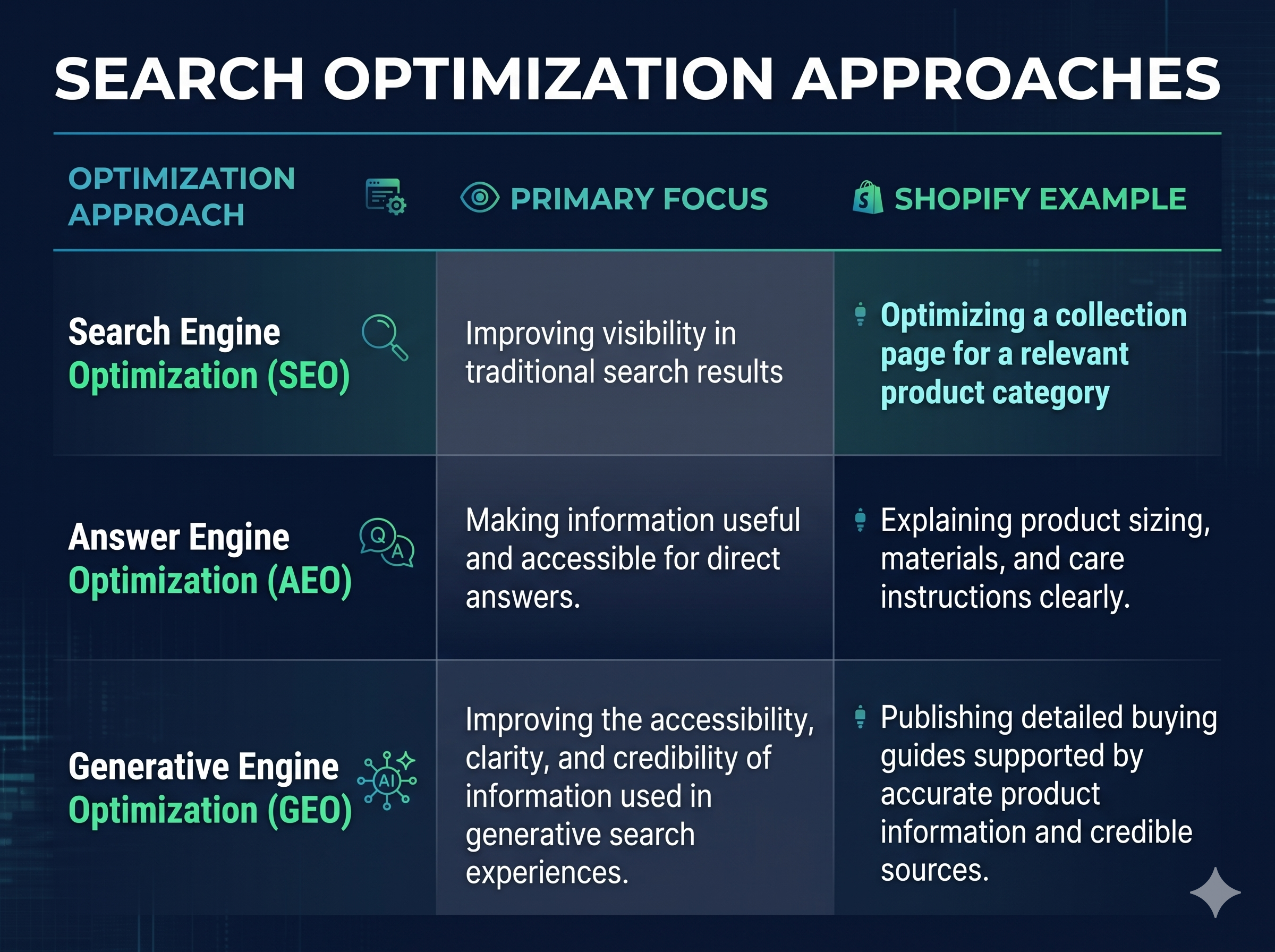
These approaches overlap considerably. Helpful content, technical accessibility, and clear product information can support multiple types of discovery.
For a deeper comparison, read our guides to GEO vs. SEO and SEO vs. AEO. You can also explore our Answer Engine Optimization services and Generative Engine Optimization services.
Importantly, none of these approaches guarantees rankings, AI citations, or product recommendations. Their value comes from building a technically sound website with useful, accurate, and relevant information.
Why Does AI Search Matter for Shopify Stores?
AI-powered search experiences are changing how users discover and evaluate information. Instead of browsing multiple websites independently, shoppers may ask conversational questions such as:
- Which winter jackets are suitable for extremely cold weather?
- What should I look for when buying a lightweight travel backpack?
- Which products are suitable for a particular skincare routine?
- How do two products compare in terms of material, price, and durability?
These queries require more than a page that repeats a target keyword. Search systems need access to relevant, understandable information that helps address the user's needs.
For Shopify brands, this makes product specifications, comparison content, category relevance, and brand credibility important areas to evaluate.
Potential benefits of AI search optimization
1. Additional discovery opportunities
Relevant content may be surfaced through AI-powered search experiences alongside traditional organic search results.
2. Better-informed purchasing decisions
Detailed product specifications, comparison guides, and transparent policies help shoppers determine whether a product meets their requirements.
3. Stronger topical relevance
A well-organized collection of useful content can demonstrate expertise within a particular product category.
4. Improved customer experience
Answering common questions before purchase can reduce uncertainty and help customers navigate their buying journey.
These are potential benefits rather than guaranteed outcomes. Results depend on content quality, competition, product data, implementation, and the systems used by each search platform.
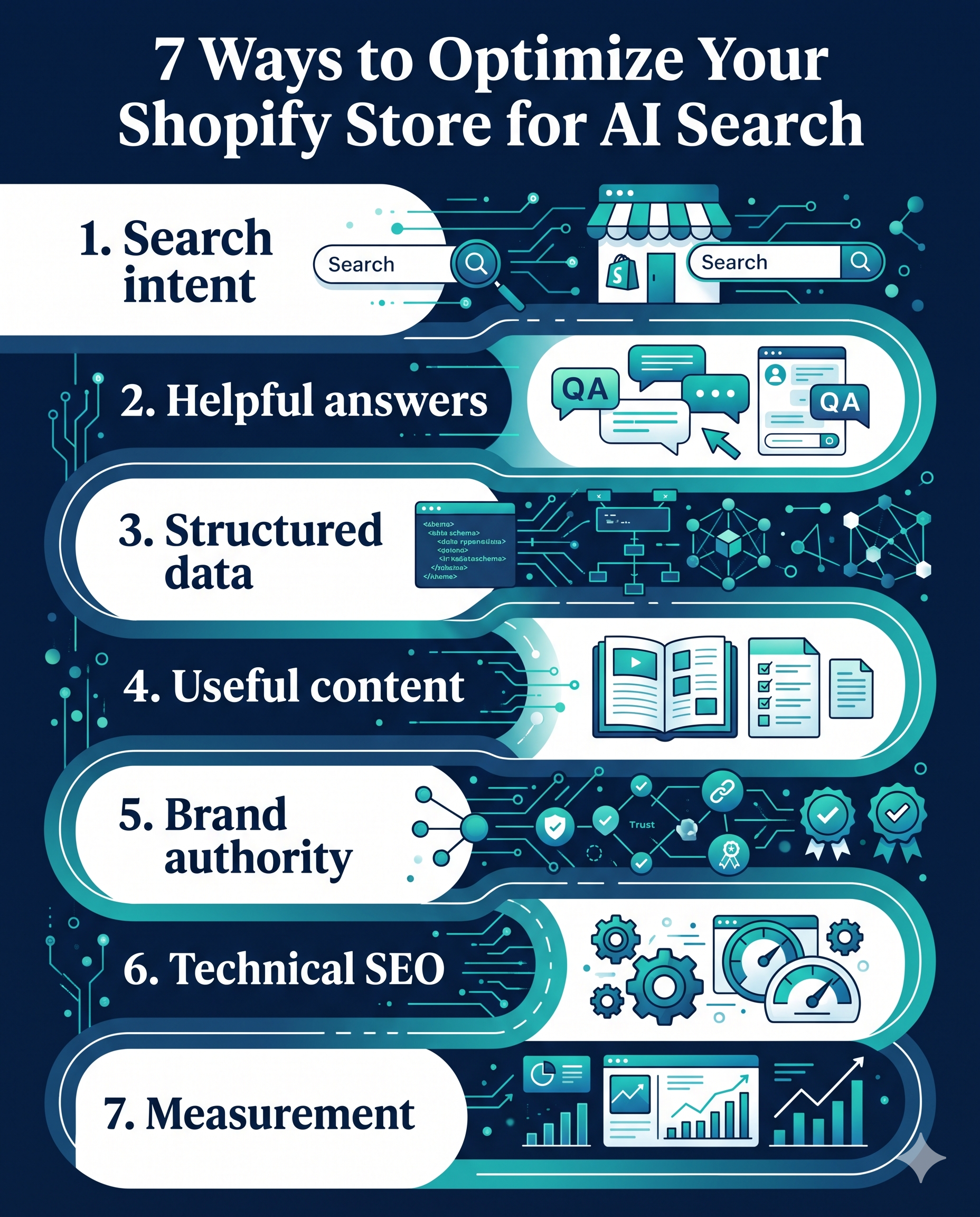
7 Ways to Optimize a Shopify Store for AI Search
1. Optimize Product and Collection Pages for Search Intent
Product and collection pages are central to e-commerce SEO because they help customers discover products and understand available options.
A common mistake is focusing exclusively on primary keywords while neglecting the questions shoppers need answered before making a purchase.
For example, a Shopify store selling winter clothing should not rely only on a collection title such as "Women's Winter Jackets."
The page could also explain:
- Which types of jackets are available.
- What materials and insulation options are offered.
- How customers can choose the right fit.
- Which weather conditions the products are designed for.
- How available styles differ.
Product descriptions should include accurate specifications, benefits, materials, dimensions, care instructions, and other details relevant to the purchase.
Collection pages should provide useful category context without becoming unnecessarily long or repetitive.
For more guidance on optimizing product pages, collection pages, and site structure, explore our e-commerce SEO services.
Actionable tip: Review your highest-value product and collection pages. Identify missing information that could prevent shoppers from understanding or comparing products.
2. Create Content That Directly Answers Customer Questions
Answer Engine Optimization focuses on making useful information easy to identify and understand.
For Shopify websites, this means creating content that addresses real questions throughout the customer journey.
Examples include:
- How do I choose the right size?
- Which fabric is suitable for summer?
- How should this product be maintained?
- What is the difference between these two product types?
- What should I consider before buying this product?
Use headings that accurately describe each question or topic, followed by direct, informative answers.
For example:
How should you choose a winter jacket?
Consider the expected temperature, insulation, outer material, fit, weather resistance, and intended use. Compare the product specifications with your requirements before selecting a jacket.
This structure helps users find information quickly and creates clearer, more useful content.
FAQs can be included when they address genuine customer concerns. Adding generic FAQ sections to every page without considering relevance is unlikely to provide the same value.
Learn more about what Answer Engine Optimization is and how it differs from traditional search optimization.
3. Implement Accurate Product Structured Data
Structured data helps search engines interpret information about products and other entities on a website.
For Shopify stores, Product structured data can communicate details such as:
- Product name and description.
- Product image and brand.
- Price and currency.
- Product availability.
- Product variants, where appropriately implemented.
- Aggregate ratings and reviews, when eligible and supported by genuine data.
- Shipping and return-policy information, where applicable.
Depending on the website structure, relevant schema types may include Product, Offer, Organization, BreadcrumbList, and WebSite.
Implementation must follow the applicable Schema.org vocabulary and Google's structured data documentation.
However, valid schema does not guarantee AI citations, higher rankings, or inclusion in rich results. Structured data should accurately reflect visible page content and should not contain misleading or outdated information.
Shopify stores may generate structured data through their themes, apps, or custom code. Adding a second implementation without auditing the existing one can create duplicate or conflicting markup.
Actionable tip: Test representative product pages using Google's Rich Results Test and review relevant reports in Google Search Console. Check for duplicate Product markup, incorrect prices, missing required properties, and mismatches between structured data and visible product information.
For deeper technical improvements, explore our technical SEO services.
4. Build Topical Authority With Helpful E-commerce Content
A strong e-commerce content strategy should cover more than transactional keywords.
Customers often research a category before deciding which product to buy. Informative articles can help your brand serve those early-stage needs while supporting relevant product and collection pages.
For example, a store selling skincare products could publish content about:
- Understanding common skincare ingredients.
- Choosing products for different routines.
- Comparing product formats.
- Understanding ingredient labels.
- Establishing a basic skincare routine.
Each article should have a clear purpose, accurate information, and a natural connection to relevant products when appropriate.
Internal links should connect informational articles with useful collection pages, product pages, and related guides.
Avoid publishing large volumes of near-identical articles simply to target variations of the same keyword. Prioritize original value, subject relevance, and the needs of your audience.
Our content SEO services can help businesses build a content strategy around relevant search intent and useful website information.
5. Strengthen Brand Authority With Relevant Mentions and Digital PR
Brand credibility matters when customers evaluate businesses and products. Search engines and AI-powered systems may also use information from multiple sources when understanding brands and selecting material for answers.
A sustainable digital PR and link-building strategy can help strengthen your online presence.
Consider these activities:
- Earn backlinks from relevant, reputable websites.
- Publish original research, surveys, or useful industry insights.
- Contribute expert commentary to relevant publications.
- Build consistent brand information across legitimate business profiles.
- Seek genuine editorial mentions from industry-relevant sources.
- Maintain accurate business, product, and contact information.
The emphasis should be on relevance, editorial quality, and genuine value rather than simply acquiring a large number of backlinks.
Paid guest posting requires particular care. Links acquired primarily to manipulate search rankings can violate Google's spam policies. Sponsored placements should be disclosed and links qualified appropriately when required.
Brand mentions and backlinks can contribute to a broader authority strategy, but neither guarantees that an AI platform will cite or recommend a particular store.
Explore our link-building services to understand how relevant link acquisition can support a broader organic search strategy.
You can also read our guide on how to get cited by ChatGPT for additional context on AI citations and brand visibility.
6. Improve Technical SEO and Product Data Quality
AI-focused content strategies cannot compensate for a website that search engines struggle to crawl, render, or index.
Shopify merchants should regularly audit their technical SEO foundations.
Crawlability and indexability: Ensure important product, collection, and informational pages can be accessed and indexed where appropriate.
Canonical URLs: Check that canonical tags identify the preferred version of each page, particularly when products have multiple URL paths or tracking parameters.
Duplicate content: Review duplicate product descriptions, collection text, and URLs created by filters or product variants.
XML sitemap: Verify that the sitemap is accessible and that important eligible URLs are being discovered.
Core Web Vitals: Monitor loading performance, responsiveness, and visual stability on mobile and desktop.
Mobile usability: Make sure product details, navigation, filters, and checkout-related information are accessible on smaller screens.
Product feed consistency: Where applicable, keep product titles, prices, availability, identifiers, and images consistent across the website and connected shopping platforms.
AI crawler access: Review relevant crawler documentation and website access rules. Requirements vary by platform, and allowing a crawler does not guarantee inclusion or visibility.
Technical audits should prioritize issues that affect important pages and actual customer journeys rather than treating every warning as equally urgent.
Our SEO audit services can help identify technical and on-page issues that may limit organic search performance.
7. Measure AI Search Visibility Alongside Traditional SEO
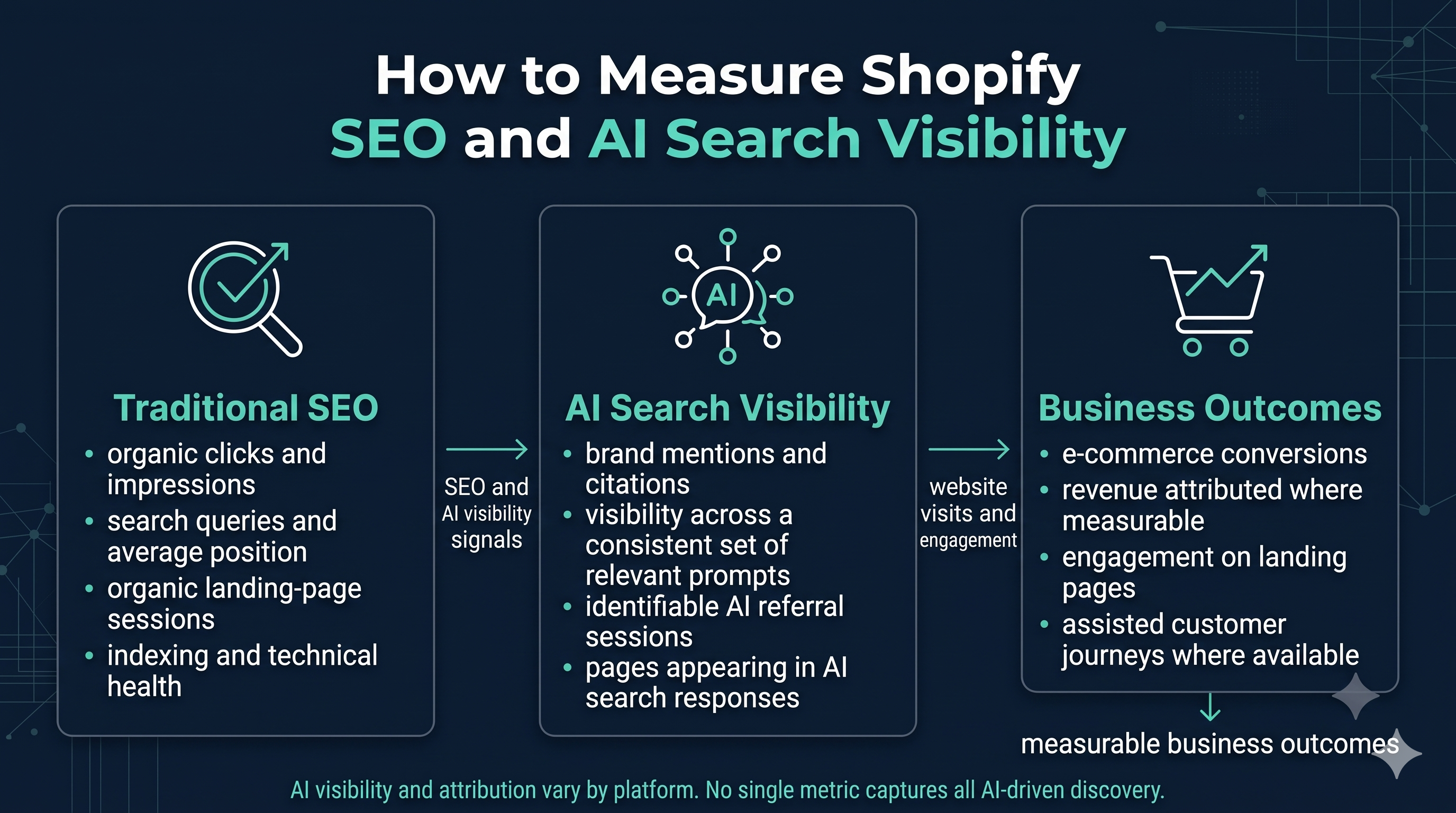
An AI SEO strategy needs a measurement framework. Without one, it is difficult to distinguish meaningful progress from assumptions.
Start with established tools such as Google Search Console and Google Analytics 4.
Track traditional SEO indicators, including:
- Organic clicks and impressions.
- Search queries and average position.
- Organic landing-page sessions.
- E-commerce conversions and revenue.
- Product and collection page performance.
- Indexing and technical SEO issues.
For AI search, establish a separate measurement layer where data is available.
Potential indicators include:
- Brand mentions and citations in selected AI search platforms.
- Referral sessions from identifiable AI platforms.
- Landing pages receiving AI-referred traffic.
- Conversions or assisted journeys associated with those sessions.
- Changes in visibility for a consistent set of relevant prompts.
AI visibility tracking is not standardized across all platforms. Some answers change between sessions, and many AI-generated interactions do not produce an identifiable referral in analytics.
Avoid treating a small set of manual prompts as a complete measure of AI visibility. Use repeatable tests, document the methodology, and distinguish observed results from estimates.
Explore our AI visibility tracking services to understand how AI search visibility can be monitored as part of a broader measurement strategy.
For a starting point, use the AI SEO Audit Tool to explore potential optimization opportunities.
For Shopify brands, the most useful objective is to connect discoverability with meaningful business outcomes wherever reliable measurement is possible.
A Practical Shopify AI SEO Checklist
Use this checklist to identify the most important opportunities before expanding your AI SEO activities.
- Audit high-value product and collection pages.
- Review search intent and identify unanswered customer questions.
- Improve product descriptions using accurate, specific information.
- Validate Product and Organization structured data.
- Review canonical tags, indexability, sitemap coverage, and duplicate URLs.
- Improve relevant internal links between blogs, collections, and products.
- Develop useful comparison guides and category-specific educational content.
- Strengthen relevant editorial backlinks and brand mentions.
- Review mobile performance and Core Web Vitals.
- Establish a baseline for Google organic performance and AI visibility.
- Review results regularly and prioritize changes based on business impact.
Start with high-value pages and critical technical issues. Expanding content and adding new tools should come after the fundamentals are in place.
Common Shopify AI SEO Mistakes to Avoid
Several practices can weaken an otherwise promising strategy.
Keyword stuffing: Repeating search terms unnaturally makes content less useful and does not create genuine topical relevance.
Publishing AI-generated content without editorial review: Automated content can contain factual errors, generic explanations, and repetitive information. Review every page for accuracy, originality, usefulness, and brand alignment.
Adding schema without validation: Incorrect properties, duplicate markup, and inconsistent product data can undermine the quality of implementation.
Ignoring traditional SEO: Crawlability, indexability, useful content, internal linking, and site performance remain important.
Chasing AI citations without tracking business value: A brand mention is not automatically a qualified visit or a sale.
Expecting immediate results: Search visibility can take time to change, and outcomes depend on competition, implementation quality, and platform-specific systems.
A successful strategy should be built around helpful information, accurate data, technical reliability, and measurable improvements—not shortcuts or unsupported promises.
Frequently Asked Questions About Shopify SEO for AI Search
1. What is AI SEO for Shopify?
AI SEO for Shopify involves optimizing an online store's content, technical structure, product information, and brand presence to support discoverability across traditional search engines and AI-powered search experiences. It builds on established SEO practices while considering how AI systems retrieve and present information.
2. What is the difference between AEO and GEO?
Answer Engine Optimization (AEO) focuses on making content useful and accessible for direct answers. Generative Engine Optimization (GEO) focuses on improving the accessibility, clarity, and credibility of information that may be used in generative search experiences. Both overlap with traditional SEO and do not guarantee inclusion in AI-generated answers.
3. Does Shopify support structured data?
Shopify themes and apps can provide structured data, including product information. The exact implementation depends on the theme, installed apps, and customizations. Store owners should audit the existing markup before adding new schema to avoid duplication and errors.
4. Can AI search platforms recommend my Shopify products?
Products may be surfaced or referenced in AI-powered search experiences when relevant information is available and selected by the platform. Visibility depends on the platform, query, product data, content, and other factors. There is no guaranteed method to secure a product recommendation.
5. Are backlinks important for GEO?
Relevant, credible backlinks can support a broader SEO and brand-authority strategy. However, the impact of any individual backlink on AI-generated visibility is not guaranteed. Focus on editorial relevance, useful content, and legitimate digital PR rather than manipulative link schemes.
6. How can I measure AI search traffic in GA4?
Review traffic acquisition and referral data for identifiable AI platforms, then examine landing pages, engagement, and conversions. Some AI-driven visits may not be identifiable because of attribution limitations. Combine available analytics data with a consistent AI visibility monitoring process.
7. Should I prioritize SEO, AEO, or GEO first?
Start with technical SEO, helpful content, accurate product information, and a logical website structure. Then improve answer-focused content and develop a repeatable process for monitoring AI search visibility. This approach strengthens the foundation shared by all three disciplines.
8. How long does Shopify AI SEO take to show results?
There is no fixed timeline. Results depend on the website's current condition, competition, content quality, technical implementation, and the search platform. Track a baseline before making changes and monitor organic performance, AI visibility, and business outcomes over time.
9. Is an AI SEO audit useful for an e-commerce website?
An AI SEO audit can help identify areas to investigate, such as content clarity, technical accessibility, structured data, and brand visibility. Its usefulness depends on the checks performed and the quality of the recommendations. Audit findings should be validated against the website's actual implementation and available performance data.
Conclusion: Build a Search Strategy That Goes Beyond Rankings
Shopify SEO is expanding beyond the traditional search results page. As consumers explore products through multiple search experiences, e-commerce brands need a strategy that combines strong technical foundations, useful content, accurate structured data, and credible brand information.
SEO, AEO, and GEO should not be treated as competing disciplines. Together, they provide a framework for helping customers discover, understand, and evaluate products across changing search experiences.
For Shopify businesses, the starting point is straightforward: improve your most important pages, answer real customer questions, maintain accurate product data, strengthen your online authority, and measure results consistently.
At Relentless Vikas, our approach to search visibility combines established SEO practices with emerging AI search opportunities to help businesses build a more sustainable digital presence.
Want to Improve Your Shopify Store's Search Visibility?
Identify potential SEO and AI visibility gaps before deciding where to invest your optimization efforts.
Start with the Relentless Vikas AI SEO Audit Tool to explore opportunities for improving your website's discoverability.
Need a more tailored strategy? Request a call with our team to discuss your e-commerce SEO goals, technical challenges, and AI search visibility priorities.
Build a stronger foundation for search visibility—across traditional search and emerging AI experiences.
Keep reading


Does ChatGPT name your brand?
Run the Free AI SEO Audit and see where you stand, in about a minute.