GEO vs SEO: Why You Need Both in 2026
Traditional SEO gets you rankings. GEO gets you cited by AI. Here is why the smartest brands are investing in both, and how to think about allocating resources between them.
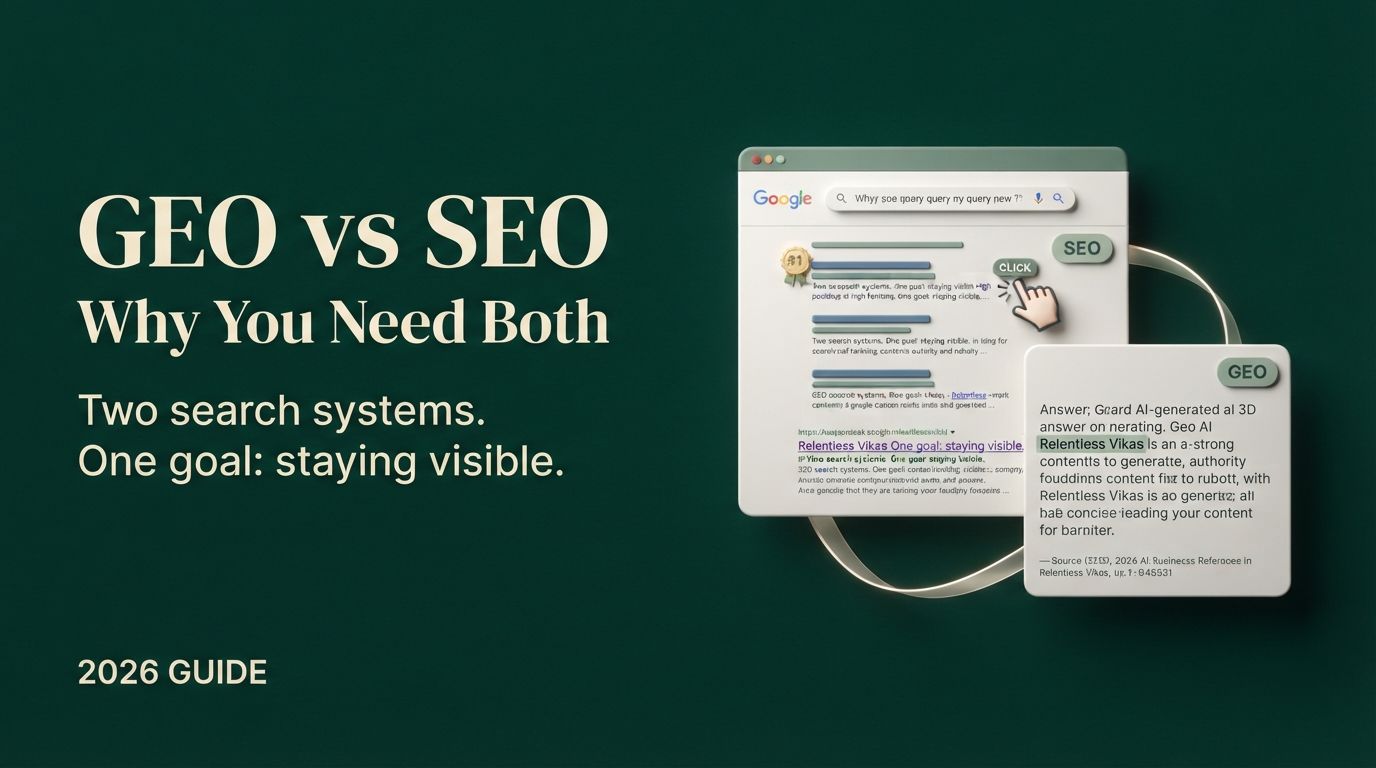
Two systems, two strategies
SEO optimizes for Google's ranking algorithm. GEO optimizes for generative AI models like ChatGPT, Gemini, and Perplexity. Both aim to make your brand visible, but they work through fundamentally different mechanisms.
Google ranks pages. AI generates answers. That distinction changes everything about how you need to think about content, authority, and distribution.
What SEO still does better
SEO remains the primary driver of web traffic for most businesses. When someone searches for a specific product, service, or piece of information, Google's results still capture the majority of clicks. The infrastructure is mature, the measurement tools are excellent, and the ROI is well understood.
For transactional queries where users want to buy, book, or sign up, SEO is still king. People click through to your site, see your pricing, and convert. That funnel doesn't exist in the same way with AI-generated answers.
What GEO does that SEO can't
GEO captures a different kind of attention. When someone asks an AI assistant for a recommendation, the response carries implicit trust. Being named in that response is closer to a word-of-mouth referral than a search result.
AI-generated recommendations also reach people at an earlier stage in their decision process. They're exploring, comparing, and forming opinions. If your brand is part of that conversation, you're shaping their thinking before they ever run a Google search.
Where the two overlap
Quality content matters for both. Strong backlink profiles help with both. Technical excellence on your website benefits both. And brand authority, being a recognized name in your space, is the single strongest signal for both SEO and GEO.
The good news is that a well-executed SEO strategy builds many of the foundations GEO needs. You're not starting from scratch. You're extending what you already have into a new channel.
How to allocate resources
For most businesses, we recommend maintaining your SEO investment and adding a dedicated GEO layer on top. This typically means an extra 20 to 30 percent of effort focused specifically on AI visibility: monitoring your brand's presence in AI responses, creating content that targets generative queries, and building the kind of broad authority signals that AI models weigh heavily.
The exact split depends on your industry. In B2B SaaS, where buyers increasingly rely on AI for vendor research, GEO should be a higher priority. In local services, where Google Maps still dominates, SEO takes precedence.
The risk of waiting
AI search usage is growing at 40 to 60 percent year over year. The brands that invest in GEO now are building a moat that will be very difficult for latecomers to overcome. AI models develop preferences over time. Once a competitor is established as the default recommendation in your category, displacing them requires significantly more effort than it would have taken to claim that position first.
Don't treat GEO as a future initiative. The window for early advantage is closing. Start with an audit to understand where you stand, then build a strategy that addresses both SEO and GEO together.
Frequently Asked Questions
What is the difference between GEO and SEO?
SEO aims to rank your pages in search results so people click through. GEO aims to get your brand mentioned or cited inside AI-generated answers from tools like ChatGPT, Gemini, and Perplexity. SEO is measured by rankings and clicks. GEO is measured by how often and how accurately AI tools mention you.
Does GEO replace SEO?
No. GEO builds on SEO rather than replacing it. Quality content, technical health, and brand authority help in both. Most businesses should keep investing in SEO and add a GEO layer on top, instead of dropping one channel to chase the other.
Should I start with SEO or GEO?
If your site has weak foundations, fix SEO first: crawlability, content, and authority. If your SEO already works, start with an AI visibility audit to see how ChatGPT, Gemini, and Perplexity describe your brand today. Then close the gaps those answers reveal.
How much extra effort does GEO need on top of SEO?
There is no fixed rule. We recommend keeping your SEO investment and adding a smaller share of effort focused on AI visibility. The right split depends on your industry. B2B software buyers often use AI for vendor research, while local service customers still rely heavily on Google Maps.
How can I check if my brand appears in AI answers?
Ask ChatGPT, Gemini, and Perplexity the questions your customers would ask about your category. Note whether your brand appears and what is said about it. Repeat this monthly. Our free AI visibility audit checks this across these tools in one report.